

Sewage, drinking water, wells: what to check before buying a house in southern Burgundy
By Arthur Lignelet · 15 May 2026
Most country houses around Cluny are not on mains drainage. What the SPANC inspection says, who pays for compliance works, and what to check on the water supply.
By Arthur Lignelet, manager of the Story’s Cluny agency
In my day-to-day work at the Cluny agency, I regularly meet buyers who have fallen for a longère, a maison de maître or a stone house in a nearby village — Salornay, Cormatin, Berzé, Taizé. It is often love at first sight. Then comes the question nobody asks at the start of the viewing, but which can turn a fine project into a financial nightmare: how is the house’s waste water treated? Where does the water come from?
In rural Burgundy, most of the properties I sell are not connected to mains drainage. They rely on a private sewage system — a tank, a drainage field, sometimes a micro treatment plant. Some are also supplied, wholly or partly, by a private well. These two subjects are the most costly blind spots in a property transaction in southern Burgundy. Here is everything you need to know before signing.
1. Private sewage systems: what exactly are we talking about?
Non-collective sewage (ANC) concerns every home not connected to the public sewer. In France, about 5 million homes are in this situation, and the proportion is much higher in rural areas — in Saône-et-Loire, most hamlets and isolated villages use private systems.
There are three main families of installations:
The traditional septic tank (today really an all-waste-water tank, which treats all waste water, from toilets and from sinks and showers). It provides pre-treatment, followed by treatment through an underground drainage field or a sand filter. It is the most common historic system in the old houses of the Clunisois.
The compact filter (coconut fibre, zeolite or rock wool). More modern and more compact, ideal for small plots or poorly permeable soils.
The micro treatment plant. An all-in-one system combining settling, biological treatment and clarification in a single tank. Efficient and space-saving, but it needs electricity and regular maintenance.
Old septic tanks in the strict sense (which only treated toilet waste) may no longer be installed since 2009. Yet many remain in old houses — and that is precisely where the trouble starts when selling.
2. The SPANC inspection: compulsory, paid by the seller, valid for 3 years
The SPANC (public service for non-collective sewage) is the intercommunal body that checks the compliance of private installations. Every sale of a property not connected to mains drainage requires a SPANC inspection.
A few essential rules:
- The inspection must be less than 3 years old when the final deed of sale is signed. Careful: the 3 years are counted from the final deed, not the preliminary contract. If the report expires in between, it must be redone. Service-public
- The inspection is carried out by a SPANC officer at the seller’s request and expense. Expect between €100 and €250 depending on the local authority.
- The report is attached to the technical survey file (DDT), like the energy rating, asbestos or electricity surveys.
The classic trap: some SPANC reports state that certain points could not be checked (inaccessible manholes, buried tank with no visible cover). The report is then partial. As a buyer, read it carefully: what could not be checked may reveal a major non-compliance once access works are done. At the agency, I always advise my clients to ask for an additional inspection if points are left open.
3. Non-compliance: who pays, who does the work, and when
This is the point buyers understand least, and the source of the biggest negotiations I handle.
If the installation is not compliant, the seller has no legal obligation to do the work before the sale. The buyer must carry out the compliance works within one year of the deed of sale. Ohsolution-assainissement
This rule changes everything in the negotiation. In practice, there are two scenarios:
Scenario 1 — The seller pays for the works before the sale. Less common, but it gives a “clean” property that is easy to sell.
Scenario 2 — The seller passes the cost to the buyer, with a discount on the price. This is what happens in most transactions. Your agent’s role is then to cost the coming works precisely and build that cost into the negotiation. An uncosted non-compliance is lost margin for the buyer, or a dispute for the seller.
Penalties if the one-year deadline is missed: a financial penalty equal to the sewage charge the owner would have paid if connected to the mains, which the municipal council can increase by up to 400%. The municipality can also serve formal notice and claim penalties. And beyond money: since the 2022 Climate and Resilience law, the notaire passes the buyer’s details to the SPANC at the sale. In other words, the SPANC knows exactly whose door to knock on if nothing is done.
4. The real cost of bringing a system up to standard in 2026
The figures I give my clients in Cluny, based on the actual quotes I see in the region:
Type of new installation · Price range (incl. VAT and installation)
All-waste-water tank + standard drainage field · €5,000 – €9,000
Tank + compact filter (coconut fibre, zeolite) · €7,000 – €10,000
Micro treatment plant · €7,000 – €12,000
Complete replacement of an old system (turnkey) · €9,000 – €15,000
To these amounts, add:
- Compulsory soil study before the works: €300 to €600
- SPANC inspections before and after the works: €100 to €300
- Regular emptying of the tank: €150 to €300 every 2 to 4 years
- Annual maintenance contract (compulsory for micro treatment plants): €100 to €250 a year
Good news for buyers: reduced VAT at 10% applies to compliance works if the home is more than 2 years old (almost always the case in southern Burgundy) and the works are done by an approved professional. The interest-free eco-loan can finance up to €10,000 for main residences built before 1 January 1990 — almost all of our local housing. Some water agencies (including the Rhône-Méditerranée-Corse water agency, which covers our area) also offer grants depending on the period.
5. Drinking water: mains supply or private well?
The second subject, often forgotten during viewings, is the water supply. In the Clunisois and the surrounding villages, there are three cases:
Connection to the public drinking-water network. This is the standard case, run by the local water board. Expect normal consumption for a family house, with a predictable annual bill. Simply check at the viewing that the meter is accessible and in good condition, and ask for the latest bills to anticipate the cost.
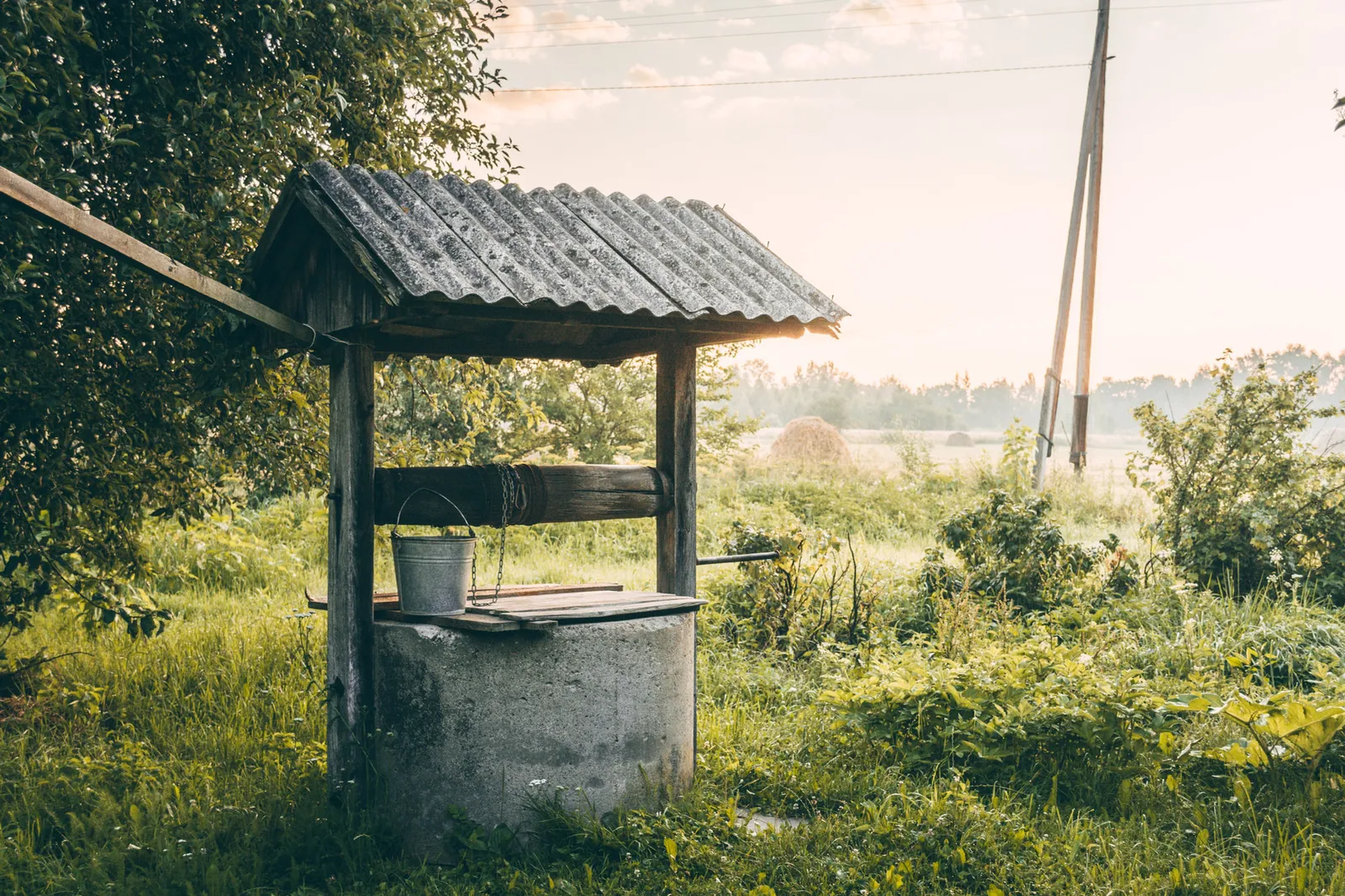
Supply from a private well only. Less common, but it still exists in some hamlets and isolated properties. This calls for several crucial checks:
- Is the water declared drinkable? If it is used for human consumption, the well must be declared at the town hall and the water quality analysed regularly by an approved laboratory (a “P1” analysis of the basic bacteriological and chemical parameters, about €80 to €150).
- Is the flow sufficient? A well that runs dry in summer is a major problem, especially with Burgundy summers becoming drier in recent years.
- Is the water table protected? Nearby intensive farming, old dumps, neighbouring septic tanks: all of these can compromise quality.
Mixed set-up (mains + well). Very common in southern Burgundy. The mains supply the kitchen and bathrooms, the well serves the garden, watering and sometimes filling the pool. This is generally the most comfortable set-up, provided the two networks are properly separated (connecting a non-potable well to the house’s internal network without an approved disconnection device is strictly forbidden — it is a strict health check).
6. Questions to ask before signing a preliminary contract
Here is the checklist I always give my buyers before they make an offer on a rural property in southern Burgundy:
- Is the SPANC report provided, less than 3 years old and complete (all points checked)?
- Is the installation declared compliant, compliant with reservations, or non-compliant?
- If non-compliant, has the seller had the works costed? How much, and by which firm?
- When was the tank last emptied? Is the invoice available?
- Is the house connected to the drinking-water network? If not, is the well declared, inspected, and the water analysed?
- Are there easements for drainage pipes or a drainage field on a neighbour’s land?
- Is the installation sized for the current number of main rooms and any future extension?
Conclusion
Sewage and water are not glamorous subjects. They do not appear in the listing photos and charm no one during a viewing. But they can mean €8,000 to €15,000 of works in the year after the purchase or, worse, disputes with the municipality and the neighbours if everything has not been checked.
My role at the Cluny agency is precisely to make sure these subjects are never an unpleasant surprise. For every property I sell, I require a complete SPANC file, I check the water situation, and I support the negotiation by giving these elements their fair value — on the seller’s side or the buyer’s.
If you are preparing a purchase in southern Burgundy and want to deal with these technical questions with peace of mind, I am available to talk about it.
Arthur Lignelet, manager of the Story’s Cluny agency, arthur@storys-international.com, +33 3 85 20 77 40
Thinking of selling in Paris or southern Burgundy?
Get a precise, reasoned valuation of your property. A personal reply within 24 hours, confidential and without obligation.